Name: Cinderella
Age: 18
Family: Stays with Father, Stepmother, Stepsister.
Social position: Low-class
Lifetime objective:
"I want to have a life of my own."
Personality traits:
- Lively - Easygoing - Optimistic
- Excitable - Even-tempered - Thoughtful
- Quiet - Kind - Loving - Compromising
- Bubbly - Humble - Hard-working
- Patient - Easily bullied - Timid
Things she does:
Housework all day
Loves to sing
Loves the company of animals
Day-dreams a lot
Inner feelings:
Sad and angry but has to be strong as she is being controlled tightly.
Yearns for freedom.
Wants to rebel but has no ability to do so.
Related actions:
Smooth and flowy.
Bends the knees a lot.
Keeps the head low.
Swift exits and entrances.


this entails"
(THIS IS LATE,again! SORRY!)
Issac, Scriptwriter:
He is responsible for coming up with a story that links Cinderella with Chinese Opera. He would need to find the similarities and differences in order to do that. He would use to base story of Cinderella and edit from there. He has to make sure that Cinderella's 'magical factor' still remains without losing the conventions of Chinese Opera. A need to research clearly every convention in Chinese Opera!
Wen Zhen, Costume Designer:
She is responsible for researching on costumes! Different dynasties have different forms. Different colours have different meanings too. Different roles will have different designs. She would need to make sketches of each role. Due to limited resources, the budget is kept low... So she have to make sure the materials we are using can be made into the design she drew!
Saad, Movement coach:
He is responsible for choreographing most of our movements. He will have to research -watch, read, learn- on Chinese Opera movements a lot! Each role have their own movements and every action has a different meaning. He must know how to costume restricts certain movements so he has to work with Wenzhen about how it does.
Priscilla- Director (O.I/C)
She is responsible for researching on the history of Chinese Opera as well as elements in fairytales. She will have to justify why we chose to use these two very different 'things' together. The conventions of Chinese Opera, the backstory of Cinderella and how these two links together. She would need to collaborate with Isaac about the script. She is also dealing with the other technical skills like set,music,lights. Being the O.I/C, she will need to pull everyone together and make sure that we do our own work! Most notifications are sent by her and final decision through her too.
MY ROLE(Rachel), Makeup designer:
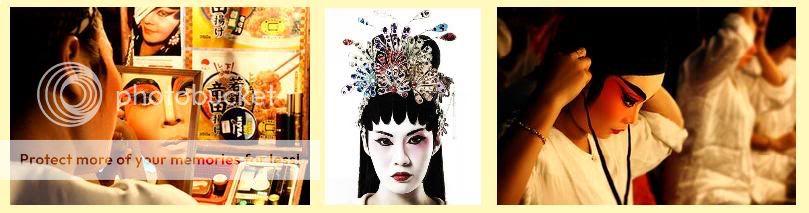
I am responsible of researching for the different types of makeup for different roles. I will have to do online research and make sketches of the makeup on each role. I also need to know how to apply the makeup properly and make sure we have practice on it as it takes a long time to learn the proper skill. I would have to find out where to get the face paint and hopefully, it would be in budget! I would ensure each of us learn how to apply the makeup ourselves as it is a convention that actors and actresses put on their own makeup.
These are lively, vivacious young female characters. They normally wear short blouses with pants or skirts. Unlike the Guimen Dan, the Hua Dan focuses more on movements and speech. They must be able to speak quickly and clearly. They also need to project an image of cuteness and innocence as Hua Dan always represent girls of around 12-16 years old. Often, a Guimen Dan is accompanied by a Hua Dan maid. Hong Niang (红娘) of the Romance of the West Chamber (西厢记) and Yan Xijiao (阎惜姣) of Wulongyuan (乌龙院) have involved the role of Hua Dan.

Huadan is a role for a vivacious maiden, a young woman with a frank and open personality, or a woman of questionable character.
Stepsister: CaidanCaidan, also called Choudan, represents clownish and cunning females. The performance of this part calls for exuberance.
Stepmother: LaodanLaodan usually represents aged women. He/She sings in their natural voices, in a style similar to that of Laosheng but in milder tones. In some types of opera, Laodan is called Fudan or Bodan.
Fairy Godfather: JingThe Jing (净) is a painted face male role. This type of role will entail a forceful character, so a Jing must have a strong voice and be able to exaggerate gestures.
Each design is unique to a specific character.
The patterns and coloring are thought to be derived from traditional Chinese color symbolism and divination on the lines of a person's face, which is said to reveal personality.
- Red stands for loyalty and general goodness (and hence is virtually the national colour of China). Black stands for wisdom and bravery. Gold and silver represent the supernatural.
- Pink powder (which symbolizes humor) is applied to their cheeks.
Young male characters are known as xiaosheng.
These characters sing in a high, shrill voice with occasional breaks to represent the voice changing period of adolescence. Depending on the character's rank in society, the costume of the xiaosheng may be either elaborate or simple. Off-stage, xiaosheng actors are often involved with beautiful women by virtue of the handsome and young image they project.
Websites to rmb:
Makeup: Rankou
Types of facial painting
Face-painting –The make-up that the Beijing Opera puts on the actor's face also has a special characteristic for displaying the character of the specific role. Using particular colors on the actor's face to symbolize their character and quality, role and destiny is not only the major characteristic of Beijing Opera, but also the key to understand the opera's plot.
Beijing Opera Make-up
The colour of the paint on the actors’ face gives you a clue to his or her character:
Red stands for loyalty and general goodness (and hence is virtually the national colour of China).
Black stands for wisdom and bravery.
Gold and silver represent the supernatural.
Yellow and white represent cunning and treachery
Green and blue a rebellious streak, pride, cruelty or lack of self control (the typical rebel against the Dynasty).
The proportion of the face covered in that colour indicates the degree to which they embody that characteristic.
Like many other parts of Beijing Opera, make-up is determined by convention, a Beijing Opera buff can probably tell a character from their make-up.
performance traditions / theories; analyse
suggested readings and texts for structure and
dramatic style"
"Gather creative inspiration"
We had many ideas from the start and we kept changing it.
We started off with Work vs Study life, showing how people can be different in both parts of their lives. However, it was difficult to link them up and we see no point in trying so hard to put two very different things together so we changed our idea.
We then decided to change it to a fairytale-based story.
Initially, we wanted to mix the stories like Cinderella, Snow white etc. together.
Later, we changed it to 3 princesses going through a test.
The last change was to have the 3 princesses to be sisters and preparing themselves to meet the prince. The inspiration was from Mulan!
We wanted to show stereotypes. Princesses are stereotypes. They are all known to be kind, gentle, loving, demure and so on. However, to show our DV: "Nature VS Nurture", we created the 3 princesses in such a way that they are not those stereotypes. They are real beings with real characters of their own.
"analyse suggested readings and texts for structure and dramatic style"
-I had posted this in "Rojak: Main" during the June Hols when I didn't know we need an individual blog...
The play was the first of Ibsen's to create a sensation and is now perhaps his most famous play. The play was controversial when first published, as it is sharply critical of 19th century marriage norms. It follows the formula of well-made play up until the final act, when it breaks convention by ending with a discussion, not an unravelling. It is often called the first true feminist play, although Ibsen denied this. The play is also an important work of the naturalist movement, in which real events and situations are depicted on stage in a departure from previous forms such as romanticism.
Meanwhile, Dr. Rank, a family friend, flirts with Nora before revealing that he is terminally ill with Tuberculosis of the spine (a contemporary euphemism for congenital syphilis), with only a month to live, and that he has been secretly in love with her. Frightened of being fired by Torvald, Krogstad approaches Nora, declaring he no longer cares about the remaining balance of her loan but will preserve the bond to blackmail Torvald into keeping him employed. Krogstad informs Nora that he has written a letter detailing her crime and puts it in Torvald's mailbox, which is locked.
Nora tells Christine of her predicament. Christine says that she and Krogstad were in love before she married, and promises she will convince him to relent.
Torvald tries to check his mail before he and Nora go to a New Year's party, but Nora distracts him by showing him the dance she has been rehearsing for the party. Torvald declares that he will postpone reading his mail until the evening. Alone, Nora contemplates suicide to save her husband from the shame of the revelation of her crime, and more important to pre-empt any gallant gesture on his part to "save" her.
Christine tells Krogstad that she only married her husband because she had no other means to support her sick mother and young siblings, and that she has returned to offer him her love again. Krogstad is moved and offers to take back his letter to Torvald. However, Christine decides that Torvald should know the truth for the sake of his and Nora's marriage.
Back from the party, Doctor Rank gives his letters of death to the Helmers, and Nora talks to him as if nothing is going to happen. Torvald goes to check the mail; Nora does everything to stop him but fails. Torvald goes to read his letters and Nora prepares to take her life. Before she has the opportunity, Torvald intercepts her, confronting her with Krogstad's letter. In his rage, he declares that he is now completely in Krogstad's power—he must yield to Krogstad's demands and keep quiet about the whole affair. He berates Nora, calling her a dishonest and immoral woman and telling her she is unfit to raise their children. He says that their marriage will be kept only to maintain appearances.
A maid enters, delivering a letter to Nora. Krogstad has returned the incriminating papers, saying that he regrets his actions. Torvald is jubilant, telling Nora he is saved as he burns the papers. He takes back his harsh words to his wife and tells her that he has forgiven her. He also explains to her that her mistake makes her all the more precious to him because it reveals an adorable helplessness, and that when a man has forgiven his wife it makes him love her all the more since she is the recipient of his generosity. (WHAT THE HECK!)
By now Nora has realized that her husband is not the man she thought he was, and that her whole existence has been a lie. Her fantasy of love is just that—a fantasy. Torvald's love is highly conditional. She has been treated like a plaything, first by her father and then by her husband. She decides that she must leave to find out who she is and what to make of her life. (FIGURING OUT HER REAL IDENTITY!) Torvald insists she must fulfill her duty as a wife and mother, but Nora believes she also has duties to herself. From Torvald's reaction to Krogstad's letters, Nora sees that she and Torvald are strangers to each other. When Torvald asks if there is still any chance for them to rebuild their marriage, she replies that it would take "the greatest miracle of all": they would have to change so much that their life together would become a real marriage.
The play ends with Nora leaving, while Torvald hopefully ponders the possibility of "the greatest miracle of all", punctuated by an infamous door slam.
Personal reflection:"A Doll's House criticises the traditional roles of men and women in 19th-century marriage. Nothing was considered more holy than the covenant of marriage, and to portray it in such a way was completely unacceptable; however, a few more open-minded critics such as George Bernard Shaw in England found Ibsen's willingness to examine society without prejudice exhilarating. " quoted from Internet.
I think that this play is COOL.
It would be more welcomed in this century as we're more open-minded now :)
It is presented in a way that the wife takes control of the marriage at the end.
In the beginning, the wife is totally submissive to her husband and she would do anything that pleases him. Her husband addresses her with tenderness and authority, calling her his “skylark” and his “squirrel.”
In the play's progression, she revealed her secret of helping her husband! It shows that a wife is actually capable of assisting the husband. Feminist :)
She is also seen as a very emotional creature as she is seen as happy, depressed, crazy etc.
COOL PLAY, that guy sucks ):
----------The above are done during the June Hols when I should've posted----------
I didn't the instructions properly!
